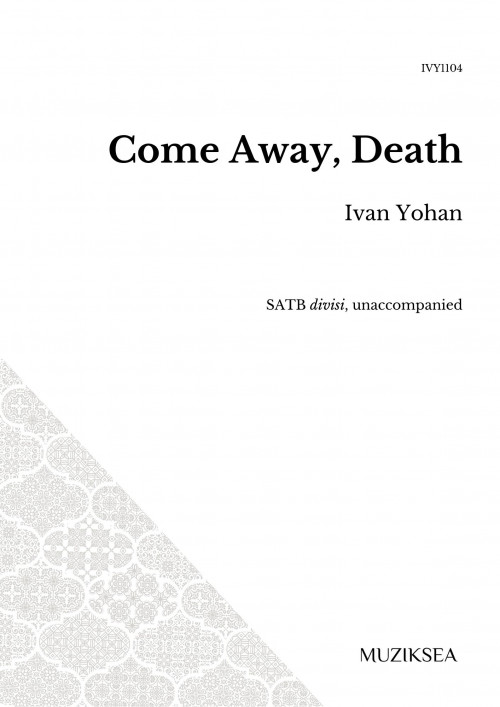
Come Away, Death (SATB)
Composer's Notes
Among all of Shakespeare’s sad poems, I find that “Come away, death” is one of the darkest and the most tragic ones. The feeling of loss and emptiness are present in each phrase like a never-ending lamentation. I started the first line by a descending lament bass line of the early music style - in this case, the lowest voice parts of each phrase going with a descending line to the lower 5th of the initial tone with a chromatic gesture to intensify the feeling of sorrow. The theme of this lament bass goes further until bar 11 when it is no longer going down a fifth but it jumps up an octave higher before descending back to the original tone, while still holding the chromaticism movement.
In a contrasting manner, beginning in bar 14 (Tempo I), the composition turns into a homophonic writing to reflect the feeling of being passive and to just deliver the request “and in sad cypress, let me be laid”, until the feeling burns into a cry on bar 20-21.
In bar 22, the first musical theme comes back. The music goes calmer again to deliver another request “my shroud of white stuck all with yew, o prepare it”. What follows next is an image of death, with lower and lower notes. The section that starts with bar 47 is a mirror of the descending lament bass line is used to give an image of flowing tears.
Unlike most of the musical sentences throughout this composition, the very last chord is a clean A minor without any dissonances. This clear tonic chord is used to symbolize a gesture of surrendering after a troubled heart.
- Availability
- Digital Only
- Genre
- Secular
- Voicing
- SATB
- Accompaniment
- Unaccompanied
- Composers (By Country)
- Indonesia
- Language (Group)
- English